How To Compare Options For A Renter Friendly Lighting Update That Can Move With You
A practical step-by-step guide to how to compare options for a renter-friendly lighting update that can move with you, including preparation, instructions, common issues, tips, and next steps.
How To Compare Options For A Renter Friendly Lighting Update That Can Move With You
This guide helps renters choose lighting upgrades that are temporary, damage-free, and portable, comparing options like plug-in sconces, battery-powered fixtures, and smart bulbs. You'll learn practical criteria for comparing them so your lighting can move with you to your next home without leaving marks or triggering deposit deductions.
Fast Answer
- Prioritize fixtures that mount without drilling or permanent adhesive, so you can remove them cleanly when you move.
- Choose lighting that runs on batteries or plugs into existing outlets, since rewiring or hardwiring is rare for rental-friendly upgrades.
Before You Start
- List every room where you want to change lighting, and note both the current light source and the nearby outlets or surfaces.
- Decide which lighting tasks matter most, such as warm ambiance for reading, bright task light for work, or accent lighting for art.
- Look up your lease's rules on wall fixtures, adhesives, and modifications so you know what is allowed and what might violate the agreement.
- Measure the areas you plan to light to ensure any new fixture will fit and will not block doors, windows, or existing switches.
Step-by-Step Instructions
Set Your Lighting Priorities and Criteria
Begin by writing a short list of what you need from each lighting upgrade. For example, you might want a reading lamp beside the sofa, a brighter option for the desk, or a soft glow for the bedroom. On that same paper, write down your non-negotiable limits, such as no drilling, no permanent adhesives, and a maximum size that fits your space. Then create columns for 'plug-in', 'battery', 'smart bulb', and 'adhesive mount' so you can compare options objectively. This step matters because having clear criteria prevents you from falling for a pretty fixture that you later cannot use in your rental or cannot move. When you shop, you will instantly know which products fit your boundaries and which ones are deal-breakers.
Compare Plug-In vs. Battery vs. Smart Bulb Options
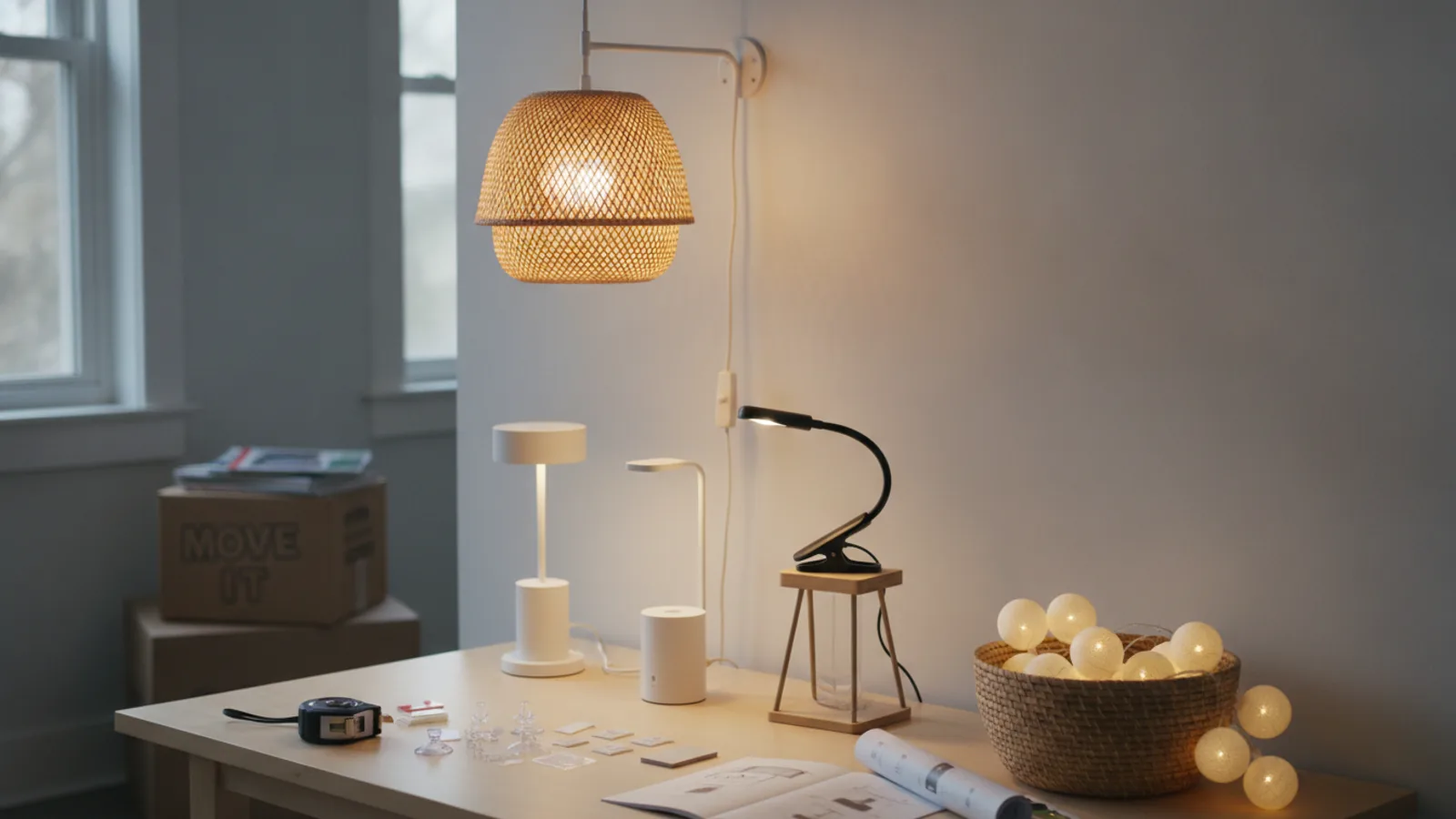
Plug-in lighting requires an outlet but usually offers consistent power and brighter output. Battery-powered fixtures are fully portable but may need frequent recharging, and some use special batteries that cost more over time. Smart bulbs fit into existing sockets and let you control brightness, color, and schedules from an app or voice assistant, but they require compatible wifi. Compare how each option meets your criteria, and read the product description to see whether the bulb is dimmable, what kind of socket it needs, and how long the battery lasts between charges. Your actual trade-off is between convenience, portability, and ongoing costs. Check that your chosen option works with your existing lamp bases or fixtures, and confirm that the charging or battery replacement method is something you can handle in a rental without special tools.
Evaluate Mounting Methods for Temporary Use
Plug-in sconce lights often use a mounting plate that you screw into the wall, which is not rental-friendly unless you are willing to fill holes later. Adhesive strips or clips can hold lightweight fixtures, but they may not stick well to textured or painted surfaces, and removing them can damage paint. Look for products that offer a 'no-drill' installation kit, such as an adhesive plate that can be removed with a hair dryer. Test the adhesive on a small, hidden area first, and evaluate whether the fixture feels secure or wobbles when touched. Solid mounting matters because a loose light is a safety hazard and could fall and break. If you are not comfortable with adhesive, choose a floor lamp, table lamp, or clamp light that needs no wall mounting at all and can simply move with you.
Assess Light Quality and Controls
Compare the brightness, color temperature, and dimming ability of each lighting option. Look for the lumen count (overall brightness) and the kelvin rating (warm or cool tone) in the product specifications. Warm light around 2700K is cozy for bedrooms and living rooms, while cool light around 5000K is better for task areas like kitchen counters. Test a smart bulb's app to see if it offers scheduling, timers, and color changes that you would actually use. Check how easy it is to turn the light on and off, whether it has a physical switch, a remote, or a motion sensor. Good light quality affects how you feel and how well you can see, so do not overlook this step. Consider whether you want a single light or a multi-bulb setup, and whether you need a dimmer to create atmosphere without a permanent dimmer switch.
Compare Portability and Packing for Future Moves
Think about how the light will travel when you move. Determine whether the fixture folds, disassembles, or fits easily into a small box. Check if the bulbs are replaceable and if you can pack them safely in bubble wrap. Consider the weight of the fixture and whether it needs special packaging to avoid damage. Also, note whether you need to remove the adhesive plate and how you will clean the wall afterwards. Ease of portability matters because you want your lighting upgrade to survive the move and be ready to use in your next home without extra work. Look for products that come with a storage bag or a mounting template that you can reuse, which saves time during your next installation. If a light is heavy or awkward, might be better to choose a lighter alternative.
Test the Light in Your Current Space and Simulate Future Use
Once you have narrowed down your options, purchase only one or two and test them in the actual room where you plan to use them. Position the light, turn it on, and assess whether it provides enough light for your tasks and looks pleasant at night. Try moving the light to a different corner to see if it works elsewhere, mimicking how you might use it in a new home. Check for glare, shadows, and whether the light is too bright or too dim. Also, test the controls and see if they are intuitive. Testing in your current space is important because it reveals the real utility of the light, not just the marketing description. If the light does not meet your needs, return it within the return window and try a different option.
Quick Reference
| Situation | Action | Why it helps |
|---|---|---|
| You want wall sconces but cannot drill into the wall | Choose plug-in sconces with adhesive mounting plates, or use a freestanding floor lamp that mimics sconce lighting. | Adhesive plates are removable without tools, while floor lamps never touch the wall, avoiding damage to the rental. |
| You need a bright task light for a desk but have no nearby outlet | Select a battery-powered LED desk lamp that offers high lumens and recharges via USB, and verify it has a long runtime. | Battery operation frees you from cords, and a long runtime ensures consistent light during work sessions. |
| You want to control lights from your phone but your rental has old fixtures | Replace standard bulbs with smart bulbs that fit into existing sockets, and install the companion app on your phone. | Smart bulbs require no rewiring and can be controlled remotely, but you must ensure your wifi is compatible with the bulb. |
Common Issues
- Adhesive strips peel off paint when removed: Use a heat source like a hair dryer to warm the adhesive before peeling, and then clean the wall with a gentle rubbing alcohol wipe.
- Battery-powered lights run out of power quickly: Check the expected runtime in the specifications, and choose options with rechargeable batteries that can be replaced or recharged.
- Smart bulbs disconnect from wifi or lose sync: Consult the product manual to reset the bulb and reconnect it to your app, and update your router's firmware if needed.
Advanced Tips
- Build a modular lighting system by mixing plug-in sconces and battery-powered accents that you can rearrange room by room.
- Use command hooks to manage loose cords along baseboards, so your lighting is organized and easy to remove later.
- Test color-changing bulbs in different seasons to adjust ambiance for shorter daylight, and schedule them with sunrise and sunset times.
Final Checklist
- Check lease rules to confirm temporary lighting and adhesives are allowed in your rental.
- Confirm that the product's mounting method will not damage walls, and test on a hidden area first.
- Verify that the light provides the brightness and color temperature that suits your room's tasks
- Ensure the light can be easily uninstalled and packed for your next move without extra hassle.
FAQ
Can I use adhesive hooks for lighting in a rental?
Adhesive hooks can be safe if you follow the manufacturer's instructions and test them on a small portion of the wall first. Use a level when applying, and remove them slowly with a hair dryer, then clean the residue. However, very heavy fixtures may not stay secure, so check weight limits and consider a floor lamp if in doubt.
Are battery-powered lights as bright as plug-in lights?
Modern battery-powered LED lights can be quite bright, but generally they are not as powerful as plug-in lights that draw from the grid. Look for high lumens, usually above 300, to get adequate task lighting. For ambient lighting, battery lights are usually sufficient. For large rooms, you may need multiple battery lights or a plug-in option.
Do smart bulbs work without a hub?
Many smart bulbs connect directly to your wifi, so they do not require a separate hub. You simply screw the bulb into a standard socket, download the app, and pair it via wifi. Some older or more advanced systems may use a hub, but many modern brands offer hub-free models. Always read the product description to confirm.